
AI Without the Hype: 5G, Robot Butlers, and What Comes Next
Viet and Natalie open the season with the question underneath the hype: what happens when the systems around us begin deciding and acting for us?


Hosted by
Viet Nguyen & Natalie Chantal Luke
“What happens when I don’t have a purpose? That’s what I’m really concerned about with AI.”
Natalie Chantal Luke
The episode
AI is already making consequential choices in systems most people never see. It predicts traffic across wireless networks, shifts capacity before a stadium crowd arrives, and turns equipment off when demand drops. The question is no longer whether machines can assist us. It is how much initiative we are prepared to hand over.
That question follows Viet and Natalie from 5G networks and satellite coverage into the messier terrain of robot caregivers, personal autonomy, legal document review, therapy chatbots, aging infrastructure, and an erroneous $5,500 electric bill. The episode does not resolve the tension. It establishes the show’s job: find the people using these systems, ask what actually happened, and keep the human consequences in frame.
Five takeaways
- 01
AI has been operating critical infrastructure for years, often invisibly, because modern wireless networks have become too complex for people to micromanage.
- 02
Agentic and physical AI make the tradeoff personal: assistance can expand independence while also weakening privacy, autonomy, or a sense of purpose.
- 03
Fast analysis is not the same as reliable analysis. Natalie’s work with 3,000-page legal and medical records still requires human review for omissions, inventions, and small details that matter.
- 04
Access is part of the product. A $20 monthly tool can be trivial to one household and out of reach for another, especially as care needs increase.
- 05
The practical AI debate is also an infrastructure debate: electricity, transmission, meters, data centers, and who bears the cost when automated systems fail.
Chapters
- 0:00
Cold open: Humans can’t micromanage AI anymore
Viet on why modern networks now depend on AI to run them.
- 0:59
Show open: Welcome to Volume Control AI
What the show is for: turn down the hype, turn up real conversations.
- 2:38
AI hype: Boomer, doomer and everything in between
The scariest claims about AI, and why the extremes dominate.
- 3:06
Meet Co-hosts Viet and Natalie
Wireless and policy on one side, creative strategy and teaching on the other.
- 3:59
Why humans can’t micromanage wireless networks anymore, AI does
Mobile data roughly doubles every two years, and people can’t keep up by hand.
- 5:36
AI at an 80,000-person concert
How a network plans for a sold-out Lumen Field show.
- 8:15
How AI helps 5G networks save energy
What each wireless generation adds, and how AI powers down idle equipment.
- 10:30
What could 6G actually look like?
A plain-English look at the generation expected around 2029 and 2030.
- 14:10
Natalie’s T-Mobile Starlink beta experience
Satellite coverage from a home where cell signal skips over the valley.
- 15:51
What happens when everybody connects on the Network?
Why a small beta group felt fast, and what changes at scale.
- 18:00
Agentic AI and the robot butler
The shift from AI that answers questions to AI that does the work.
- 21:17
What do we actually want robots to do?
Emptying the dishwasher versus giving up the tasks that shape a life.
- 23:52
Work, identity and autonomy in an AI world
How much of who we are comes from the work we do.
- 25:51
Robots, caregiving and who gets access
Caregiver shortages, Natalie’s mother, and who can afford the help.
- 31:17
Why expertise still matters when everyone has AI
From a Tandy computer and Frogger to knowing what to ask a model.
- 35:34
Has the technology outstripped the business model?
Powerful tools, and nobody quite sure what to do with them yet.
- 36:25
AI can be amazing—and still get it wrong
Natalie cross-checks tools on 3,000-page medical and legal records.
- 39:08
What would you hand over to an AI agent?
Picking one part of life to delegate for a month.
- 41:37
Where is the red line? Relationships, therapy and trust
Bills maybe, bank accounts maybe not, and the echo-chamber risk.
- 43:45
AI infrastructure meets real-world infrastructure
What the next few years of AI demand mean for physical systems.
- 47:26
Data centers, electricity and the grid in an AI world
Seattle’s one-year pause on large data centers and the power question.
- 49:47
The $5,500 electric bill — An AI dilemma
A one-day billing error and the work of disputing an automated system.
- 55:53
AI, jobs and what happens to our work
Public concern about AI, and how it has already changed Natalie’s job.
- 58:42
Is AI the new electricity?
What the rollout of electricity suggests about AI’s early, clumsy uses.
- 1:00:44
Why Volume Control is built around human stories
Why the season centers on people using AI at work.
- 1:02:02
Looking toward 2030
Hopes for the aha moments the guest conversations might produce.
- 1:03:48
Closing thoughts
Coping with the pace of change together, and where to follow along.
Resources
T-Mobile satellite coverage ↗
The satellite-to-phone service behind Natalie’s beta experience.
Google NotebookLM ↗
One of the tools Natalie uses to interrogate large source collections.
Otter.ai ↗
The transcription tool discussed in the episode.
iDesign ↗
Natalie’s Seattle brand strategy and creative direction studio.
More from the show
In this episode
- The network problem. How AI already helps wireless networks predict traffic and handle volumes of data people can’t manage by hand.
- 5G, 6G and Starlink. What happens when 80,000 people use their phones at once, and what satellite connectivity could mean next.
- The agentic shift. The difference between AI that answers a question and AI that does the work.
- The robot butler problem. Everyone wants the dishwasher emptied. How much work, purpose and autonomy do we want to hand over?
- Aging, caregiving and access. Whether physical AI can fill real gaps in care, and who will be able to afford it.
- The expertise question. Access to AI isn’t the same as knowing how to use it, especially when it leaves something out or makes something up.
- The personal red line. Bills, bank accounts, relationships, therapy and trust.
- The infrastructure problem. Data centers need enormous amounts of electricity, and the grid wasn’t built for what’s coming.
- When automated systems get it wrong. Natalie’s $5,500 electric bill.
- AI and work. What happens to expertise, autonomy and identity as jobs change.
Credits
- Hosts: Viet Nguyen and Natalie Luke
- Sound technician: Markus Luke
- Intro song: made with Suno
Your hosts
Viet Nguyen
Co-host; founder, Third Space Project
Viet is a Seattle technology executive, civic activist and former president of 5G Americas, which he led until the wireless association closed in 2026, after PR leadership roles at Microsoft and T-Mobile. Recently featured in GeekWire, he builds civic AI apps, including Culliton2026.org, which analyzes how Washington Supreme Court candidates might rule on the "millionaires' tax," and the AI system behind CivicTide, which turns Seattle City Hall data into policy briefs. He is a University of Washington alumnus.
More about Viet →Natalie Chantal Luke
Co-host; executive creative director and CMO, iDesign and iDLegal
Natalie is an award-winning executive creative director, entrepreneur and founder of iDesign and iDLegal. She has shaped creative strategy for Microsoft, Google, T-Mobile, Starbucks, Boeing and Alaska Airlines, and her courtroom narratives and visual systems have supported trial teams in cases yielding more than $210 million in verdicts and settlements. She also teaches and consults on practical AI adoption, and brings sharp questions, creative instinct and an executive's perspective to the show.
More about Natalie →Production
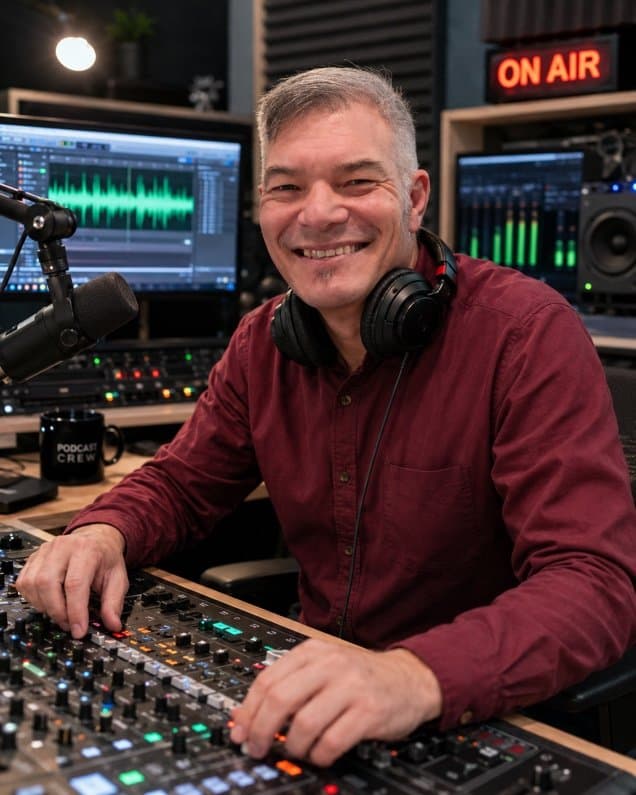
Markus Luke
Audio producer
Markus Luke is a Seattle audio engineer and music producer with deep roots in the Pacific Northwest recording scene. He did foundational work at Seattle's historic London Bridge Studio as an assistant engineer, providing musical assistance alongside producers including Rick Parashar, and contributed engineering to major-label records including Long-View's Mercury and Alex Lloyd's self-titled album. He brings decades of tracking, mixing and production experience to Volume Control.
Full transcript
Read the conversation.
Follow Season 1
The useful AI conversation is just getting started.
Subscribe once and new episodes show up as they drop, every two weeks.
Subscribe to Volume ControlKeep going