

What actually works in AI right now
A practical guide to the AI tools, research methods and human safeguards that are producing useful work for organizations in 2026.

Imagine sitting down at your desk with a state budget, several research reports and a blank page. A few years ago, using artificial intelligence for that work meant opening a chatbot, typing a question and hoping the answer was useful. Too often, the result was a polished paragraph with weak analysis or a source that did not exist.
Many leaders tried that version of AI and reached a reasonable conclusion: the technology was interesting, but not ready for serious work. Yet the tools have changed considerably since those first experiments, with research systems now able to search current information, work across hundreds of pages, compare multiple sources and help carry a project from initial question to finished document.
That does not make the technology reliable by default; it means the practical question is no longer whether AI can produce useful work. The question is how to build a workflow that captures its speed without surrendering judgment, security or factual accuracy.
I recently spent a half day working through that question with a policy research team. The examples came from their field, but the lessons apply to any mid-market organization whose work depends on research, writing and analysis. What follows is the practical stack we examined, along with the safeguards that make it usable.

A different generation of tools
The first generation of widely used AI products was largely built around a single interaction: the user entered a prompt and the model returned text. The experience was impressive because the language sounded natural, but it was also limited because the model had little access to current information, source documents or the other systems where work actually happened.
The current generation is broader, with leading tools working across text, images, audio and video. Large context windows allow them to examine lengthy reports in a single session, while retrieval systems connect answers to source material and agentic tools browse websites, use software and complete a sequence of tasks.
This shift changes the unit of work because AI is no longer limited to drafting an email or summarizing a paragraph. It can help research a bill, compare testimony, analyze a spreadsheet, prepare a briefing and turn that material into a presentation, supporting an entire workflow while each step remains subject to human oversight.
Adoption has followed that expansion. Roughly 88 percent of organizations now use AI in at least one business function, up from 55 percent in 2023, according to McKinsey's State of AI report. Users report saving about 2.2 hours per week through generative AI in the Federal Reserve Bank of St. Louis productivity research. Organizations with a visible AI strategy are also much more likely to report meaningful benefits, according to Thomson Reuters.
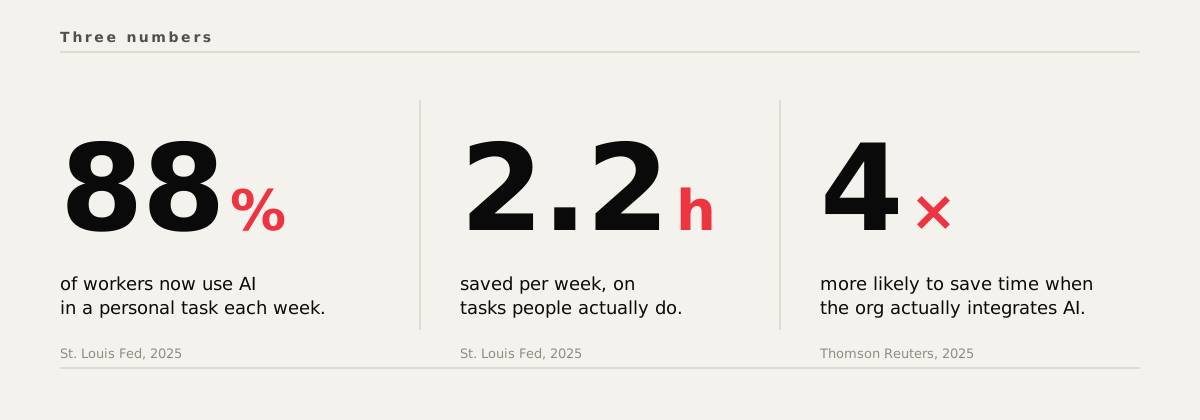
Together, these findings point toward a capacity question rather than a headcount question. AI is not just a content generator; it is becoming part of the infrastructure that determines how quickly the same team can examine more material, test more ideas and move from information to well-supported action.
Generative AI and agentic AI
The vocabulary surrounding AI has expanded almost as quickly as the products, although most leaders need to understand only two basic categories.
Generative AI produces new content, including text, code, images, audio or video, from a prompt and the context it receives. Rather than retrieving a stored answer in the traditional sense, the model predicts a useful response based on patterns in its training data and the information available during the session.
Agentic AI adds planning, memory and tools around the generative model, allowing an agent to break a goal into steps, browse the web, open files, use software and adjust when something fails. The underlying model still makes probabilistic decisions, but the surrounding system allows it to act beyond the chat window.
This distinction matters because the risks are different: a weak generative answer may contain an error in one paragraph, while an agent can carry that error into several later steps before a person notices. The additional capability creates leverage, but it also creates a larger surface for review.
Reliability remains the dividing line

The most persistent weakness in generative AI is not that it always fails; it is that a wrong answer can arrive with the same confidence and polish as a correct one. That smooth surface encourages readers to lower their guard, particularly when the subject falls just outside their expertise.
The evidence remains sobering. A study by Walters and Wilder found fabricated citations in 55 percent of GPT-3.5 responses to medical literature queries and 18 percent of GPT-4 responses, while a Stanford evaluation found substantial hallucination rates in specialized legal research products. The Charlotin AI Case Law Tracker has documented more than one thousand legal filings containing AI-generated errors.
These findings are not arguments against using AI; they are design requirements for using it responsibly. Every citation and quantitative claim intended for publication should be checked against the original source by a person who understands the context, while sensitive information remains inside systems with appropriate data controls and contractual protections.
Agentic systems add another form of reliability risk, as recent research on multi-step agent performance illustrates how quickly errors can compound. Even when a system performs each individual step with 95 percent accuracy, a ten-step process succeeds end to end only about 60 percent of the time.
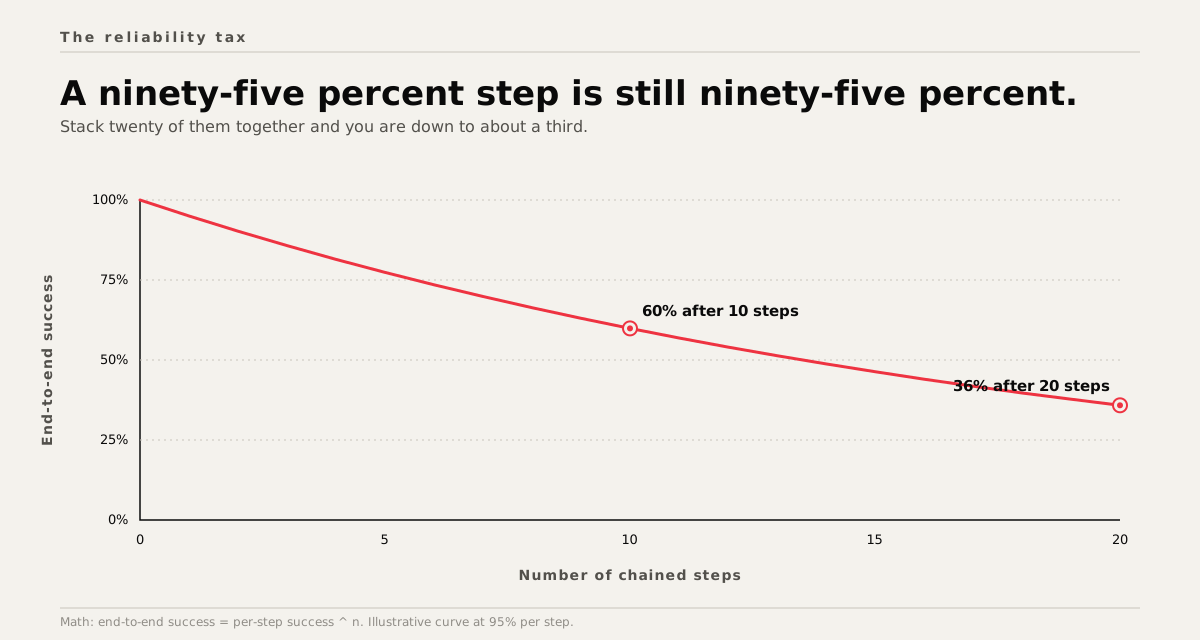
The practical response is to use agents where partial completion can be reviewed and corrected. Consequential actions, such as publishing, sending, purchasing or changing a system of record, should remain behind an explicit human decision.
The working AI stack

No single product is best at every part of the process, so the most effective stack combines specialized tools around the work an organization already performs.
Current research. Perplexity is useful for searching current information and tracing an answer back to its sources, a step that remains important because a Columbia Journalism Review analysis found meaningful citation errors across every AI search product it tested. Consensus provides a complementary layer for questions that depend on peer-reviewed research.
Deep research. Deep research systems read many sources and return a structured report with citations, but products vary in speed, depth and final format, as this comparison of leading research tools demonstrates. The right choice depends on the assignment because a short executive briefing and a comprehensive literature review should not begin with the same settings.
Source synthesis. NotebookLM turns a selected collection of reports, transcripts and web pages into a working knowledge base. Because responses point back to the uploaded material, it is especially useful when a team needs to understand its own documents rather than search the entire web.
Drafting and reasoning. ChatGPT, Claude and Gemini can all support drafting, critique and structured analysis, but the better approach is to choose one primary tool, learn its strengths and build repeatable practices around it. One particularly useful exercise is the steelman: ask the model to construct the strongest good-faith case against the draft, which often surfaces assumptions that friendly internal reviewers miss.
Data analysis. Modern models can examine spreadsheets, write analysis code and return charts with supporting tables, making exploratory analysis accessible to teams that may not have a data specialist available for every question. The output still requires review, especially when the source data contains missing values, changing definitions or unusual formats.
Visuals and presentations. Image generators and presentation tools can shorten the path from an idea to a usable first draft. GPT Image is helpful when visible text or a controlled layout matters, while Gamma and NotebookLM can turn an outline or source collection into an editable deck that still needs human review for accuracy, tone and brand.
Agents. Tools such as ChatGPT Agent Mode, Claude Computer Use and Perplexity Comet can browse, write code and interact with websites. They are most useful when the task is recoverable and the checkpoints are clear because the objective is supervised execution, not blind autonomy.
The common thread is specialization: a research-driven organization benefits more from a connected set of tools, each assigned to a defined job, than from expecting one product to manage every stage.
A workflow that holds together
Individual tools create isolated gains, while a repeatable workflow creates organizational capacity.
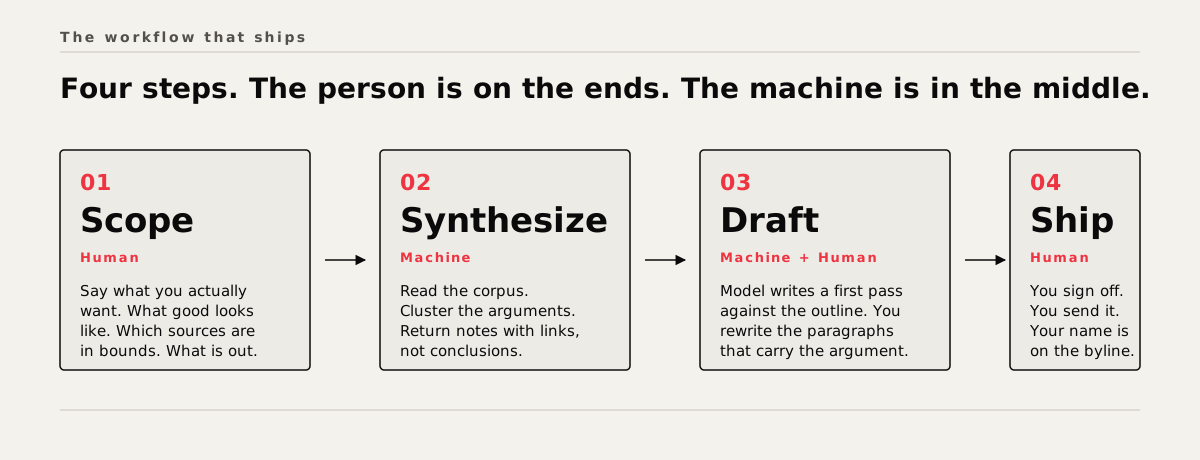
The first step is scope: define the question, identify authoritative sources and decide what a credible answer would require. AI can help locate relevant material, but a person should decide which sources belong in the working set.
The second step is synthesize: load the strongest sources into a controlled workspace and ask the model to identify findings, disagreements and unanswered questions. The goal is not merely to summarize each document, but to understand how the evidence fits together.
The third step is draft. Use a capable reasoning model to organize the argument, test alternatives and produce an initial version. Quantitative work can happen here as well, provided that the analysis and underlying tables remain available for review.
The final step is ship: a person verifies citations, checks every material number and reviews the work for tone, context and fairness. Presentation tools may help with formatting, but accountability stays with the person who approves the final product.
This human review is not an additional layer placed on top of an AI workflow; it is part of the workflow itself. Without it, the organization has faster output but no reliable way to know whether that output deserves trust.
Building useful habits
The strongest AI programs rarely begin with a broad transformation initiative, but with a narrow workflow, a small group of committed users and enough time to learn where the tools help.
Start by selecting one recurring assignment with visible value, whether researching a policy question, preparing a client briefing or analyzing a monthly spreadsheet. Run the complete workflow for several weeks and document where time was saved, where quality improved and where human review caught errors.
AI use should also be visible inside the organization, particularly because a KPMG and University of Melbourne study found that many employees conceal their use of AI from managers. Hidden use prevents leaders from setting boundaries, teaching better methods or learning which practices are already producing value.
A short weekly session can help by asking team members to demonstrate one prompt, research method or workflow that worked. Practical examples from colleagues are more useful than another generic training course because they connect the technology to familiar work.
Finally, expect the stack to change as specific products improve, merge or disappear. The durable assets are the team's ability to frame a problem, evaluate evidence, protect sensitive information and maintain human responsibility at the point of consequence.

The AI market has moved beyond the stage where leaders can evaluate the technology through a single chatbot experience. These tools are becoming part of the research, production and administrative infrastructure of modern organizations, with their value determined by how they are connected to real work.
The path forward is neither universal automation nor permanent skepticism, but disciplined adoption: choose a meaningful workflow, use the best tool for each stage and keep people responsible for the decisions that matter.
As these systems become more capable, the central question will no longer be what AI can produce, but whether organizations can build the judgment and operating discipline required to use it well.
If your team is working through that question, that is the conversation we are having at 3rd Space Project.
Written by

Viet Nguyen
Co-founder, 3rd Space Project
Viet runs advisory at 3rd Space Project and co-hosts Volume Control. Based in Seattle. Writes about what he is seeing across the work.